Designing selective compounds, and getting them to the mitochondria.
Tibolone was made to treat hot flushes. That it also keeps brain cells alive through a metabolic crisis was never the plan, and for a long time nobody could say why it happened. That is the difference between a drug that works and a drug we understand. Only one of the two can be improved on.
The answer has to do with where the receptor sits. Estrogen does not signal through a single receptor, and they are not interchangeable. Alpha is the main transcription factor of the family, and much of what estrogen does in reproductive tissue runs through it. Beta is the one that turns up somewhere unexpected. It has been found inside the mitochondrion itself (Yang et al., 2004), which is a strange address for a protein filed under gene transcription. Both receptors can be found there, but they probably do not do the same job once they arrive, and beta is the one that carries the protection. If the question is how hormones keep a brain cell's energy running, that is where the evidence points, and it is why we design around beta rather than around estrogen in general.
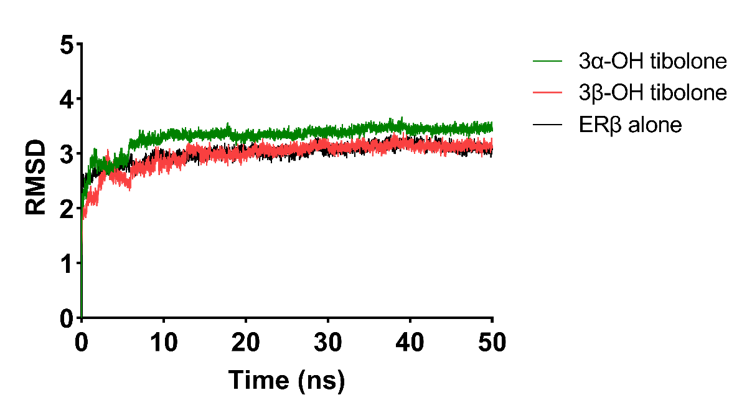
So we looked at how tibolone reaches it. When the body breaks the drug down, the pieces it produces fit into that receptor, and we know the shape of the fit down to the atom. We watched them hold in place through molecular dynamics simulations, long enough to be confident it is real. A lucky accident became a structure, and a structure is something we can work with.
β-tibolone metabolite in complex with estrogen receptor beta.
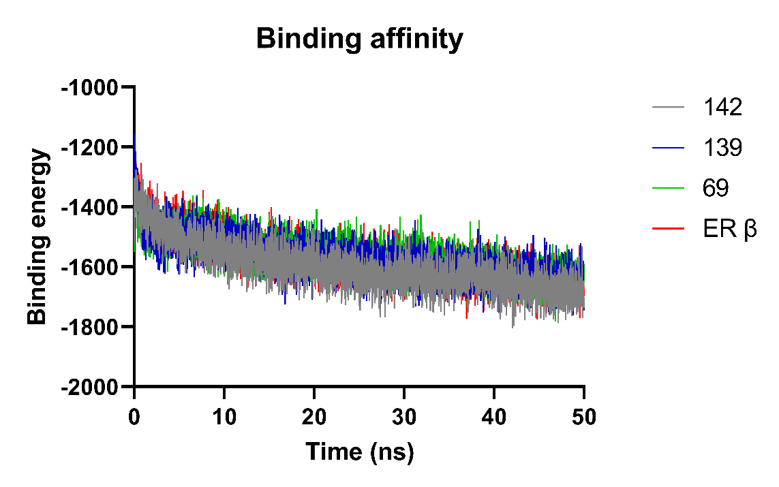
Then we went looking for better ones. Screening compounds against the same receptor turned up three, numbered 142, 139 and 69, that bind it with high affinity. Binding tightly is not the same as binding well. What we want is a compound that speaks to beta and stays quiet everywhere else.
Fitting the receptor is not the same as arriving at it. A compound has to cross into the brain, and then cross again into the mitochondrion, and most of what looks good on a screen fails at one of those two doors. Tibolone walks through both already, which is a large part of why we keep returning to it. Anything we design has to clear the same bar, and that is a harder test than affinity.
Molecular dynamics studies showing the root-mean square deviation of tibolone metabolites in complex with estrogen receptor beta.
Ligand-drug screening identified ligands 142, 139 and 69 to bind with great affinity to estrogen receptor beta.
Nothing here stays on a screen. A compound that looks good in silico goes back into astrocytes from male and female donors, where the whole argument either survives or it does not. That is the circle closing. A hormone, a mitochondrion, a mechanism, a molecule, and then back to the cell to find out if we were right.